AI has probably never encountered the above sentence in public before, and it probably doesn’t know what it says (at least at the time I write this, anyway),1 for you see the English Phonotypic Alphabet is only just now supported by the standard digital text encoding known as Unicode, allowing large language models (LLMs) to understand the words as they are, rather than mediated through images.
Indeed, until just recently, the sequence of codepoints (a Unicode term meant to avoid confusion with the 8-bit characters of older digital text) in “Ɛlas and Mɋrgɋret Loŋli” did not have a fully-agreed-upon meaning, at least in the digital world. Only with the release of Unicode 18 were all the characters defined such that the sequence has a standardized meaning of sorts, namely a phonotypic spelling of the names of Elias and Margaret Longley, the namesakes of my font Longley, used in the above image, this article (when viewed with the associated fonts, anyway), and elsewhere on this site.
Yes, welcome to the first release of the (non-romanic) Longley font family, a family designed to highlight the descendant of the English Phonotypic Alphabet known as the American Phonetic Alphabet, colloquially the Cincinnati Alphabet.
To be specific, Longley (and the Longley Romanic variant used elsewhere on this site) is a revival of the Scotch-face type used in the Loŋli Bruđerz [Longley Brothers] publication Bografiz ov đɛ Prezidents ov đɛ Ynted Stꞛts [Biographies of the Presidents of the United States], published in 1856 CE. The book itself is arguably one of the more fascinating artifacts of the Usonian fascination with phonotypy (the transcription of speech into phonetic type) and one of only a handful of full-sized books published in the phonotypic alphabet in the United States of America. As a result, it is only fitting that its type be used as the basis of one of the first fonts targeting coverage of the phonotypic letters added in Unicode 18.
The funny thing about phonotypy (pronounced FOH-nuh-tie-pee) is that it made it into Unicode first. Well, before Isaac Pitman’s shorthand system anyway. And yet for as popular Pitman’s shorthand was in the United Kingdom and parts of the United States of America during the nineteenth and early twentieth centuries (compared to the relative bust that was his phonotypy), it is Pitman’s work in phonotypy that has had the more visible long-term impact, through its role in originating the small letter forms of esh [ʃ] and ezh [ʒ] now used in the International Phonetic Alphabet and the alphabets of various languages based on it.2 So in some sense, perhaps its earlier addition to Unicode is better-deserved after all.
Still, it was Pitman’s shorthand that actually came first in 1837, following a series of experiments to develop a new kind of shorthand to represent each of what Pitman perceived to be the 40 phonemes of English with a distinct sign or diacritic mark. His shorthand soon proved successful with a small number of enthusiasts and, by 1842, Pitman had started a periodical, The Phonographic Journal, largely in shorthand, for 500 subscribers.
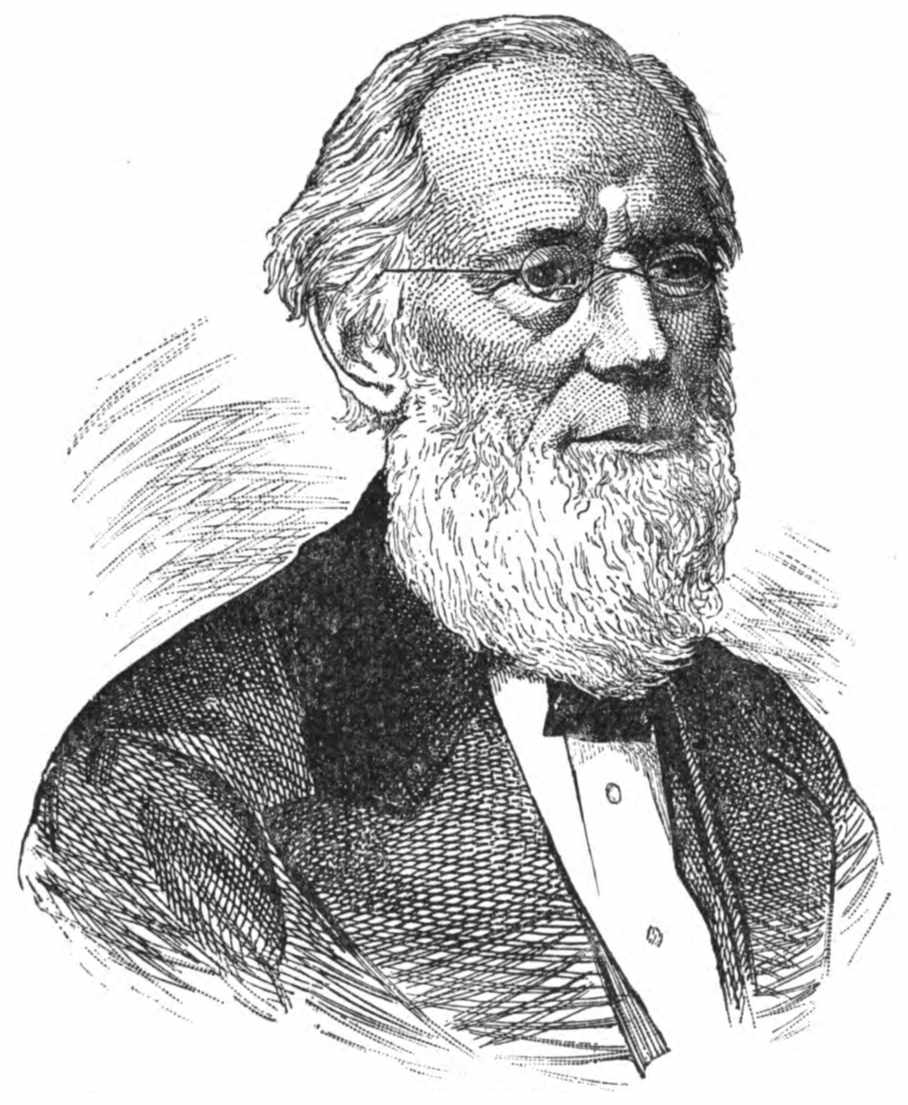
Isaac Pitman (1813–1897), the British inventor of Pitman’s shorthand (phonography) and phonotypy.
[Courtesy of Packard’s Short-Hand Reporter and Amanuensis, available at HathiTrust]
Soon after starting the Journal, however, Pitman was forced to acknowledge the immense practicality of movable type in expressing the phonetics of English to, and communicating with, an ever-increasing number of correspondents with the Journal, and by the third issue, in March of that year, he resolved to embark upon a course of designing an appropriate typeface to do so. The following January, Pitman added twelve pages of lettertype to the Journal in the form of The Phonotypic Journal, and by January 1844, the first pages were printed in the new type, cast by Messrs. Figgins.
The early years of phonotypy in The Phonotypic Journal were marked by a series of experimental alphabets as Pitman worked to refine them from a single case of small capital letters to one with both capital and small letters over the course of 1844, thanks to the technical and financial support of the Cambridge-trained linguist Alexander John Ellis. This was then followed by a series of incremental modifications to the alphabet throughout 1845 and 1846, as can be seen in the series of changes to the name of the Journal itself, taking first the name Ƌɩ̇ Fɷnɷtipic Jurnal in June 1845, followed by Ƌi Fɷntipic Jrnul, Ƌɩ̇ Fɷnɷtipic Jrnal, Ƌi Fɷnɷtipic Jurnal, and, finally, in September 1846, Ƌɛ Fɷnɷtipic Jurnal, a name it was to retain with only one final minor modification of the small letter a to small letter alpha (Ƌɛ Fɷnɷtipic Jurnɑl) upon the stabilization of the alphabet in 1847.3 Accompanying this alphabet were a smattering of curious punctuation marks intended to help the phonotypic reader to not only understand when traditional (romanic) orthographies were being quoted as is, but also to better convey the emotional valence of human speech.4
Throughout this period, the Journal is replete with reports relating to the 1845 arrival of Pitman’s shorthand to Usonian shores at the port city of Boston, followed by the first Usonian newspaper printed in phonotypy in both Boston and New York in December 1846, Ƌɩ̇ Aŋglɷ Sɑcsun [The Anglo-Saxon]. Printed using a font cast in Boston by S.N. Dickinson & Co., the alphabet used in the paper was based on an intermediate version of the alphabet in use by Pitman as of June 1845, for which the editors, Stephen Pearl Andrews and August H. Boyle, had procured a small sample of type directly from England.5 The weekly newspaper continued in print for over a year before it ceased regular publication in September 1848 due to business troubles, though Andrews would continue to promote phonotypy into the early 1850s.
With the aid of Andrews, Boyle, and others, interest in phonography (in the form of Pitman’s shorthand) quickly spread throughout the United States of America during this period, as various individuals who first learned phonography in the coastal cities where it had first arrived became traveling lecturers, teaching the art to others. Across the country, phonographic societies sprang up in their wake to sustain this new-found interest in phonography and phonotypy, including in cities like Cincinnati, Ohio. It was here that a 23-year-old journeyman printer employed by the Universalist newspaper Star of the West, Elias Longley, first encountered them.
While Albert Donalds George’s 1955 dissertation on the role of the Longley Brothers in the phonotypic movement fails to note exactly how Elias learned phonography and phonotypy, he noted that the first issue of Ƌɩ̇ Aŋglɷ Sɑcsun made mention of one of the earliest phonographic teachers in Cincinnati, John S. Dickson, who advertised his success in teaching illiterate black adults to read phonotypy within 48 hours. Whether or not this feat was responsible for attracting the young Longley’s attention, Elias later noted having spent the winter of 1845/6 studying phonography under Dickson, and by January 1847, he had joined with others to form the Cincinnati Phonographic Society (later the Cincinnati Phonetic Society).
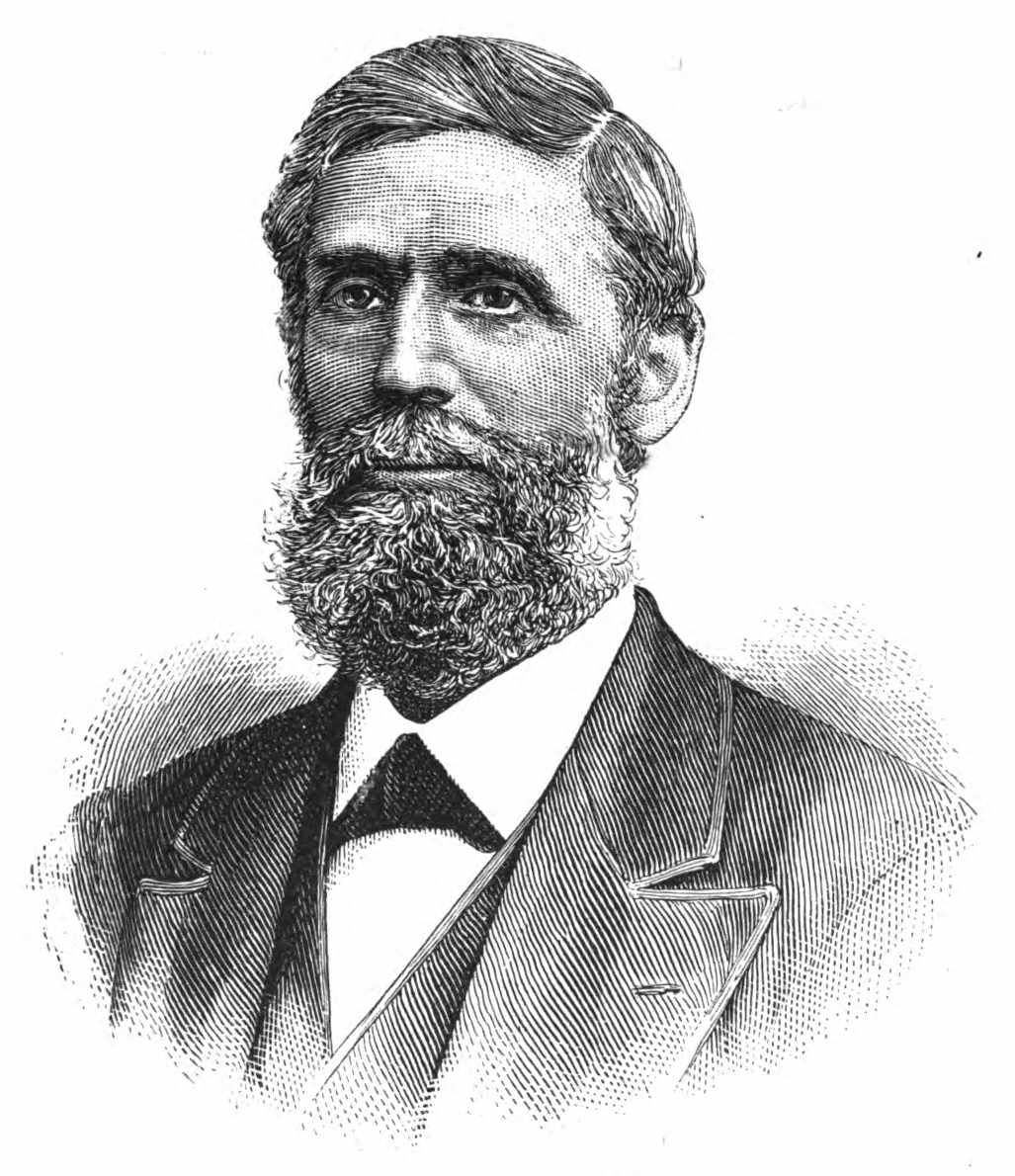
Elias Longley (1823–1899), the Usonian phonotypic printer and phonographic educator, husband of suffragette Margaret Vater (M. V.) Longley.
[Courtesy of Packard’s Short-Hand Reporter and Amanuensis, available at HathiTrust]
Elias, whose reformist background led him to be less interested in phonography’s promise for reporting than its merits as “a new and philosophical mode of writing the English language,” soon began corresponding with Pitman, expressing interest in Pitman’s new phonotypic alphabet. By July 1848, he had acquired a single phonotypic font of the 1847 alphabet from England, and together with his younger brother Servetus, also trained as a printer, became joint publishers “Loŋli & Bruđur, Publiʃurz & Printurz” [Longley & Brother, Publishers & Printers] of a periodical named Phonetic Magazine. That October, following the promising initial success of the Magazine, Elias proceeded to send Alexander John Ellis an order for additional type so as to expand his business and produce a higher-quality, more regular journal the following year, now renamed Ƌɛ Fɷnetic Advocat [The Phonetic Advocate].
By 1850, the Longleys’ labors had firmly secured Cincinnati’s place as the Usonian capital of the phonotypic movement, when Philadelphia stenographic educator Epinitus Webster reportedly procured a font of phonotype from England without the legal encumbrances that, to that point, had prevented their duplication. Webster then had the Cincinnati Type Foundry prepare matrices for the first fully Usonian phonotypic font, which led to a small number of local Usonian newspapers placing orders. That same year, the Longleys’ success led to their monthly magazine becoming a weekly newspaper, taking the name of Ƌɛ Wɛcli Fɷnetic Advocet [The Weekly Phonetic Advocate], a name it would retain through the early 1850s.
Throughout this period, the relative success of phonography and phonotypy had been rooted in the stability of the 1847 alphabet which, following the failure of Ƌɩ̇ Aŋglɷ Sɑcsun, had become the de facto standard phonotypic alphabet on both sides of the Atlantic. Nevertheless, its standardization carried with it the seeds of its dissolution, as various authors began to write to both Pitman and Longley about perceived failings of the alphabet, particularly due to the variations in spelling that necessarily resulted from carrying out phonetic transcription of different dialects within the United Kingdom and the United States of America, never mind between them.
In response to these pleas, what first began as a joint Anglo-Usonian effort to reform phonotypic spelling soon became two separate ones. In England, Pitman began new experiments with phonotypy that would return to a “continental” or “European” vowel model that resembled some of the earlier alphabets from 1845. In doing so, Pitman attempted to align the letterforms of phonotypy with the conventions of European languages, such that, by the time Pitman’s version of phonotypy had stabilized again in 1856, the open e [ɛ] would represent the close-mid front unrounded vowel /e/ rather than the close front unrounded vowel /i/, and the phonotypic i [], now paired with a new small letterform [], would represent the close front unrounded vowel /i/ instead of the diphthong /aɪ/.
In contrast, the concerns of Usonian phonotypy were, in some regards, more practical in nature. Finding the “six vowel scale” of the 1847 alphabet inadequate to the task of capturing distinctions within Usonian English speech, Usonian phoneticists soon began to explore the possibility of adopting a vowel scale with seven or eight distinctions, which would afford authors the ability to capture both the phonemic /æ/-raising present in some North American English dialects, as well as the rhotic mid central vowel /ɚ/ when stressed or standing by itself.
This, together with a number of other criticisms of the 1847 alphabet, ultimately led Elias Longley to join other phoneticists to form the American Phonetic Council, an organization of phonotypy advocates who hoped to promote the use of the alphabet in the United States of America. Throughout the early 1850s, in correspondence with the Council, Longley trialed a series of experimental alphabets to model some of the schemes that had been proposed. Though by the middle of 1853 the Council had seemingly failed to decisively agree on the design of a new alphabet, Longley continued with his experiments into the autumn and winter of 1853/4 with the hopes of soon finalizing his version of the phonotypic alphabet and pushing for its acceptance in the Phonetic Council after the fact.6
Just as Longley was concluding work on the new Usonian phonetic alphabet however, the arrival of a new phonographic educator to Cincinnati would ultimately change the course of phonetic publishing in the United States of America. In January 1853, seeking fresh opportunities after having played a significant role in spreading the art of phonography in England as a traveling lecturer, Isaac Pitman’s brother, Benjamin “Benn” Pitman, embarked for Philadelphia from Swansea. There, following a tour of the Usonian northeast which culminated in a successful series of lectures in Ohio that summer, Benn decided to settle down in the Longleys’ hometown of Cincinnati.
Pitman’s arrival soon caused some consternation for the Longleys in the form of his 1854 partnership with Randall P. Prosser, a fellow English immigrant and phonography enthusiast. Together, the two founded the Phonographic Institute, a school for the teaching of phonography with an attached publishing house. Despite the new competition from Pitman and Prosser, Elias successfully convinced the two to adopt the version of the phonotypic alphabet, now known as the American Phonetic Alphabet, that he had finalized in early 1854. Following Prosser’s decision later that year to become an independent publisher, the Longley brothers and Pitman pledged themselves, under the name of the American Phonetic Publishing Association, to use Longley’s new alphabet without alteration for the next ten years, ultimately reaching an agreement with the American Phonetic Council to adopt the same.
The two proceeded with complementary efforts to promote the new alphabet: Pitman prepared a series of readers and educational materials for children to be published under the auspices of the Association, while Elias, together with Servetus and their younger brothers Septimius, Cyrenius, and Alcander, would commit themselves to a partnership for five years as they worked towards completing the printing of Dan Smalley’s The American Phonetic Dictionary of the English Language (a unique romanic-phonotypic dictionary in which the definitions themselves were printed in phonotypy) as well as other works both phonotypic and romanic. Prosser, for his part, soon took up responsibility for publishing the American Phonetic Journal, outside the terms of the Association itself.
But while the alliance of Pitman and the Longleys held (with some difficulty) to 1859, the dissolution of the Longley Brothers partnership that year only served to underscore the fact that times had changed and that phonotypy’s heyday was over. Elias would continue his investment in phonotypy and phonography education for a few more years following the dissolution of the brothers’ partnership, but the outbreak of the Usonian Civil War led Longley to slowly dispose of his printing concern, handing his new semi-monthly, then monthly, journal, the Journal of Progress in Education and Social Improvement over to the Ohio Educational Journal, while retaining a sufficient supply of phonotypic fonts to complete a second printing of the New Testament in the American Phonetic Alphabet in 1864, effectively capping off his ten-year pledge to use the alphabet unchanged.
Following the Civil War, the spirit of reform that had led Elias Longley to support phonotypy in 1848 was not eager to return to wholesale alphabet reform. Educational reform efforts that had once considered phonotypy a promising opportunity for improving the teaching of reading and writing English now favored alternative approaches like Dr. Edwin Leigh’s “Pronouncing Orthography.” Leigh’s scheme advocated teaching students to read using a highly enriched alphabet that used a variety of letterforms for each letter so as to highlight the corresponding pronunciation in traditional Usonian English spelling, a model that presaged 20th-century phonics education.
A revival of efforts towards English language spelling reform in 1876 under the auspices of the Reformed Spelling Association, together with his ongoing success as a phonographic educator, would nevertheless lead Elias to return to phonotypy between 1878 and 1885 with the help of his younger brother Alcander, publishing a periodical named The Phonetic Educator. However, Longley soon fell prey to the urge that had rendered Isaac Pitman’s English Phonetic Alphabet increasingly irrelevant: tinkering with the phonotypic alphabet.
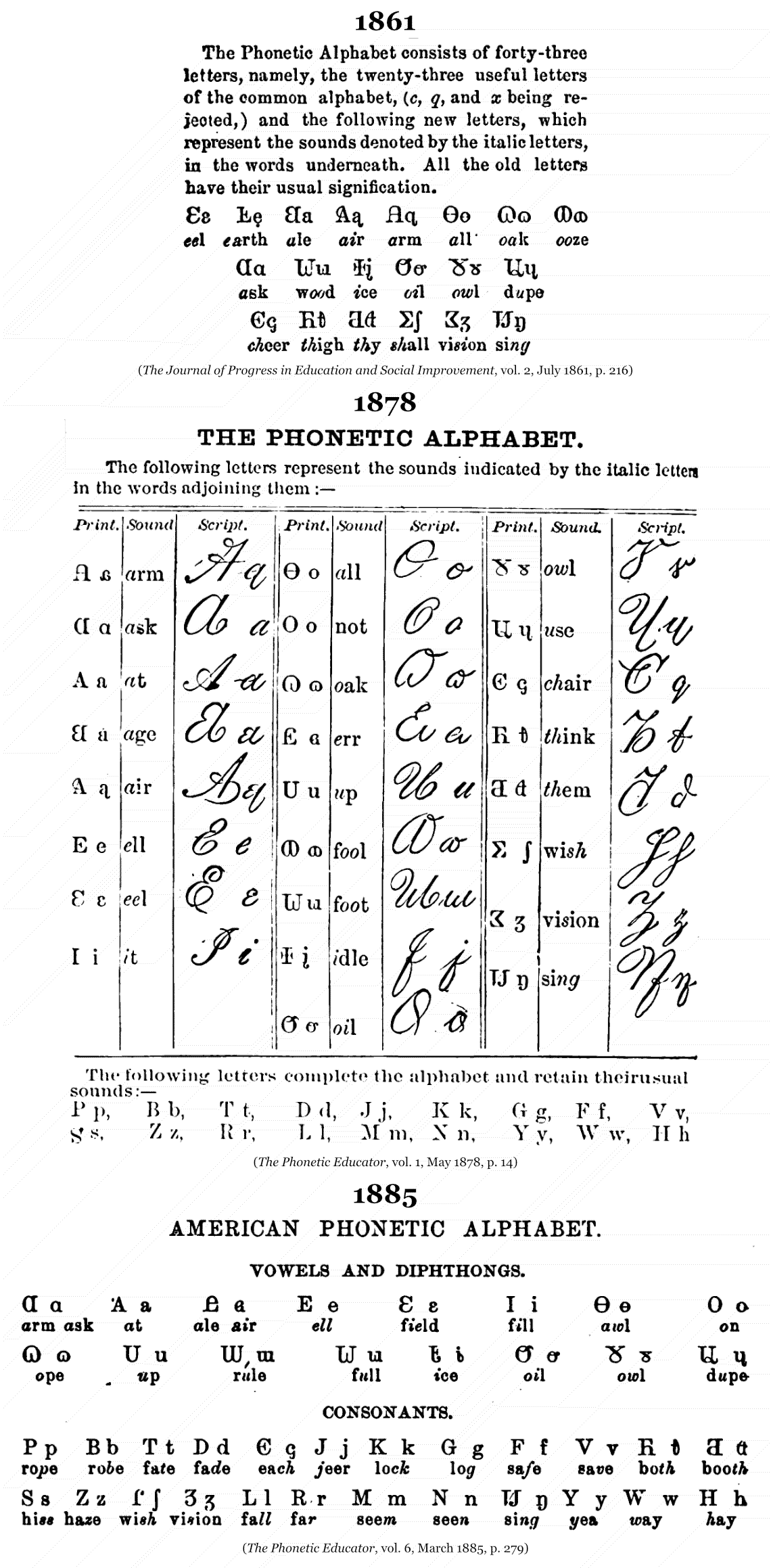
Elias Longley began to make minor modifications to the American Phonetic Alphabet even before the end of the ten-year-pledge in his Journal of Progress, but made more comprehensive changes starting with his publication of The Phonetic Educator in 1878.
Though Longley had largely stuck by the ten-year pledge to use the American Phonetic Alphabet unchanged, he nevertheless briefly flirted with changing the capital form of the letter representing the rhotic mid central vowel /ɚ/ from an E with a largely straight top-bar that bent into a ball only at its far end [] to an inverted F in the final 1861 volume of the Journal of Progress. The Phonetic Educator continued in this vein, initially restoring the capital letter to something more closely resembling its former form (albeit with a much more pronounced arc from the middle arm to the ball at its tip, as if its top half had been replaced with a capital C) while adopting as its small form a particularly alpha-shaped small e with notch [ⱸ] adapted from the letterforms of the Spelling Reform Alphabet, thereby replacing the small e with dot below [ẹ]. The phonotypy of the first few issues of The Phonetic Educator also adopted the small letterform of the round-top a [] first introduced in Pitman’s 1856 English Phonetic Alphabet to replace the alpha with descending hook [ɋ] that had previously been used with an r to represent the rhotic open back unrounded vowel /ɑ˞/.
But as Longley continued to promote his phonotypic alphabet in his books on phonography, his efforts no longer appealed to educators who, if they had not already committed themselves to Leigh’s Pronouncing Orthography or the Spelling Reform Alphabet that had brought Longley out of phonotypic retirement, soon favored simplified spelling over phonotypy as the preferred vehicle of spelling reform. No doubt by the time of his subsequent move to southern California in 1885, Elias would have had to agree with his younger self (with not a small amount of chagrin) that the Usonian people had indeed continued to improve the English language, even if that progress was no longer on the terms of his youth. For as his younger self had put it in his closing words for the Journal of Progress some twenty-four years previously, “Progress and improvement are the prevailing characteristics of the [Usonian] people.”
It was some some one-hundred-fifty-odd years after Elias Longley had printed those words that I first came across Pitman’s 1847 phonotypy, in the middle of a fit of curiosity in which I had decided to learn about various Usonian English spelling reforms in the early 19th century. At that time, I was very much in the midst of actively looking for employment in industry following a life that until that point had been focused only on academia. While I’m not entirely sure how I came around to an interest in phonotypy at such a transitional period of my life, it may well have been the result of first encountering Jill Lepore’s book A is for American: Letters and Other Characters in the Newly United States around that time.
Lepore’s work details the ways in which the young Usonian nation and the peoples who lived in it began to construct their nation through their relationship to its majority language through the 19th century. This relationship was marked as much by the efforts of Benjamin Franklin, who first persuaded a young Noah Webster to envision a Usonian English to help unite the fledgling nation (culminating in his Dictionary of American English), as it was by the efforts of men like William Thornton, a somewhat self-aggrandizing heir to several West Indian sugar plantations who spun his inherited wealth into a polymath-like interest in medicine, architecture, and linguistics. Both of these men, Franklin and Thornton, shared a view that differed from that of Webster, concluding that the remedy for the limitations of English orthography could only be found in the modification of the English alphabet, rather than the revision of English spelling standards.
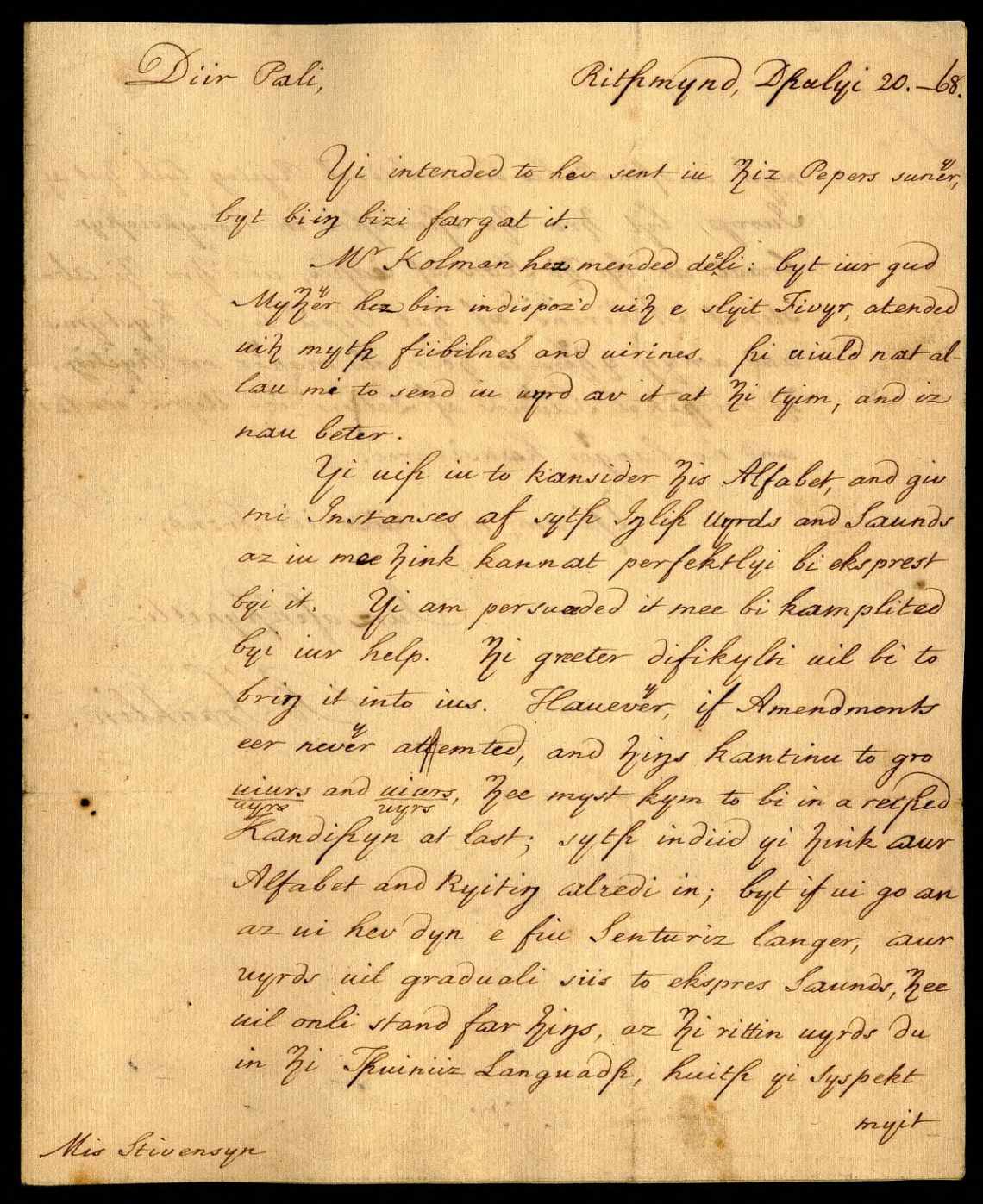
Benjamin Franklin first used his alphabet in this handwritten letter letter to Polly Stevenson Hewson dated 20 July 1768. The script letterforms were later used as a basis for the italic types used by printer Benjamin Vaughn when the letter was typeset for publication in 1779.
[Courtesy of the American Philosophical Society]
What was more striking for me, however, was not the way these men helped to frame phonetics as a discipline, but rather a much more pragmatic problem: both Franklin and Thornton’s curious additions to the alphabet could not be represented digitally in Unicode text. This discovery spurred on a short-lived study of various phonetic alphabets in the Anglosphere with the help of Google Books. Such alphabets not only included Thornton’s 1793 alphabet as presented in his book Cadmus, or a Treatise on the Elements of Written Language, but also Joseph G. Chambers’s 1817 “Orthographic Letters,” Abner Kneeland’s 1828 “New System of Orthography,” U.C. Burnap’s 1829 “Orthography of the English Language Simplified,” M. H. Barton’s 1833 “Perfect Alphabet,” Benjah J. Antrim’s 1843 “Pasigraphic Letters,” Keyes A. Bailey’s 1848 “Phonography,” the 1855 version of Andrew Comstock’s “Pamphonetic Alphabet,” and A. D. Sproat’s 1857 “Universal Alphabet.” And there, in the middle of it all, near the height of the Usonian national fascination with alternative phonetic alphabets, arrived Isaac Pitman’s English Phonotypic Alphabet, together with his shorthand, to Cincinnati, Ohio, where, only eight years later, its relative success led to its evolution into the American Phonetic Alphabet.7
Now I was fortunate at the time I was studying these alphabets to have access to a library that had original copies of Pitman’s The Phonotypic Journal, and I soon found myself particularly intrigued by the mixture of shorthand and drawn character studies that marked the early evolution of Pitman’s phonotypic letters in the pages of the Journal. But Pitman’s phonotypy, too, was then not in Unicode, with only the third of what would eventually prove to be five revisions to a proposal to add the letters to Unicode having been written at the time. And with me soon to have a job to focus my efforts on, my interests soon drifted to other things, leaving Pitman’s phonotypy and the other phonetic alphabets politely in my digital archive and memories, never front of mind.
Over a decade passed in this way, until March of this year, when, by pure happenstance, I returned to the subject of phonotypy through a Wikipedia dive only to be delighted to learn that a fifth proposal had finally succeeded in adding the characters needed for various stable versions of Pitman’s and Longley’s phonotypy to be included in Unicode 18. Indeed, my delight at learning this was so great that I finally decided to try my hand at making a typeface based on an older physical print specimen (Bografiz) so as to seriously practice designing digital typefaces for the first time in more than a decade.
Thus, Longley.
My initial research for Longley started with reference to the Scotch-face type’s Edinburgh origins in the Pica Roman No. 2 from the type foundry of William Miller, but I soon concluded that, if I wanted any hope of capturing the balance of Bografiz’s phonotypic characters correctly, I would need to study the more typical forms in that work more closely. This study would eventually lead to the final (heavier) design of the letters visible here today.
![Affinity Designer open with the traced splines of the phonotypic t [] on top of the original scanned page](/explorations/images/longley-affinity-designer.jpg)
Affinity Designer was used to initially vectorize each letterform by hand, an example of which can be seen in this initial trace of a phonotypic t [] on page 11 from Bografiz.
My workflow began by taking scans of Bografiz and several other near-contemporary specimens from the Longley Brothers’ press from the Internet Archive and then making vector traces of the best versions of each letter in Affinity Designer by hand. Once finished with a trace, I would then export the trace to SVG and re-import it into my font editor of choice, Glyphs, for further clean up. This is a simple enough process, but one that must be repeated dozens upon dozens of times to get anything reasonably useful for modern Usonian English use (never mind adding phonotypic characters to the mix). Now double all that and you might reach an understanding as to why you haven’t yet seen any use of bold or italic faces in my texts featuring Longley thus far. (And my sincerest apologies to those who might prefer better typographic eloquence for their absence.)
Given the level of effort involved to reach my goal of a complete phonotypic font by the release of Unicode 18, I needed a plan, to which I am greatly indebted to Karen Cheng and her book Designing Type, which provided me a way to methodically work through the 26 Latin capital letters most commonly used in typical English orthography, followed by the 26 small letters. This process greatly helped to stabilize the design as I slowly prepared for the more daunting task of designing the less-familiar phonotypic letters.
Now, in building a typeface like Longley in this way, one’s writings necessarily become littered with images, first letters, then words, as one begins to wrestle with having to do the hard part of font design: kerning. Needless to say, my chat logs are now littered with words and short sentences plumbing the depth of the English language, slowly sprinkling in a few bits of common punctuation, before wrestling with a few stragglers left unused in the American Phonetic Alphabet (c, q, and x) until arriving, finally, to my first reasonable looking pangram, a sentence featuring all the letters in an alphabet. In Longley’s case? An underrated classic: “Sphinx of black quartz, judge my vow.”

One of the many samples of Longley made during its creation, this rendering of the word “Hamburgefönstiv” demonstrates an early version of Longley with higher contrast between the capital and small letters, as well as a wider dieresis on the “o”, creating kerning problems with the neighboring “f”.
The standard English alphabet, once complete, was followed by a focused effort on making the font presentable for my previous entry in this series of articles, which largely consisted of a second, more holistic, round of kerning over ever-longer texts (a standard practice for working with a newly-created font), along with adding several characters needed to support the article, including several digits. This was then followed by an attempt to bring the digital typeface into print, first realized with my 2026 VCF West poster.
These attempts to wrangle the digital shapes into more consistent, more usable forms were accompanied by sporadic (and, following VCF West, more sustained) efforts to continue to expand the character set to include the more peculiar characters unique to the American Phonetic Alphabet used in Bografiz and several other phonotypic alphabets (a sample of which are demonstrated in an oddment that accompanies the release of this article). In addition, I added several letters the Longley Brothers never used in their works but which were nevertheless needed to properly present an annotated bibliography of phonetic alphabets for English that I decided to compile as well, as well as two digits that Isaac Pitman had designed in 1857 to help represent duodecimal (base-12) numbers in print [↊, representing ten, and ↋, representing eleven].
Finally, however, we arrive here, at this article, deliberately released just after the publication of the final version of Unicode 18, and your reading of it in the first version of Longley appropriate for use with phonotypy.
With the most common phonotypic letters now encoded in Unicode, where does that leave phonotypy? With its letters now bearing digital lives, phonotypy surely will now enjoy a legibility of sorts. Thousands of pages of text that hitherto had been mystifying to librarian and language model alike can, and likely will, be indexed, digested, processed, and incorporated more fully into the gestalt of linguistic understanding embodied in the databases and numeric matrices that can help shed a light on humanity in our past and present.
No doubt as you read this, the likes of AI crawlers have already consumed what modicum of novelty this article (and the oddments posted alongside it) can provide. Before long, Claude, ChatGPT, and their future progeny around the globe will gain some sense of Pitman and Ellis’s English Phonotypic Alphabet and its descendants, just as they comprehend English, Spanish, French, Russian, Japanese, Hindi, Arabic, and many other languages today. Indeed, they have undoubtedly begun to penetrate the insights hitherto locked behind cryptic spellings and unexpected letterforms embedded in digital images scanned from old books and periodicals printed in phonotypy. Though they may always struggle with understanding and generating arbitrary phonotypic texts and transcriptions (for what constitutes a legitimate token to a language model does not always correspond with one of the phonemes that phonotypy sought to bring to light) the barrier to their understanding will be forever lower than it once was.
In another sense, however, phonotypy will remain as dead as it has ever been, since the day Elias Longley was compelled to end publication of the Journal of Progress. The number of humans alive who not only want to understand what phonotypy is, but who wish to engage with it and study it and the people who wrote it has never been large. Even at its peak, not even four thousand people weighed in on the development of the American Phonetic Alphabet out of a national population of more than 23 million. Likewise, at its peak circulation in the late 19th century, Pitman’s Phonotypic Journal, which had since become The Phonetic Journal, had a circulation of 20,000 copies per week. But while far from insignificant, this level of circulation was almost certainly more a product of its relevance to those interested in Pitman’s shorthand than any sustained interest in phonotypy.
Since then, the concept of phonotypy has drifted somewhat from its original roots in Isaac Pitman’s vision of 1842 and Elias Longley’s subsequent efforts to bring about a distinctly Usonian shape to it. Dictionaries that still define the word do so in terms of the transcription of speech to phonetic text more generally, rather than making reference to any specific alphabet as they once did. In some sense then, phonotypy is still very much alive, through the efforts of linguists and dialecticians who make use of the International Phonetic Alphabet in their everyday work. Such uses might not be as grandiose as the English spelling reforms and pedagogical improvements that had once driven interest in phonotypy during its heyday, but it is nevertheless a phonotypy, even if the particular phonotypies of Pitman and Longley remain moribund at best.
And so it is that we find ourselves in the twilight of phonotypy: not dead, but no longer living and breathing as it once did in the journals and newspapers that published it. With its addition to Unicode, phonotypy simply marks another faint heartbeat in its not-quite-afterlife. The researchers and aficionados who care about it will no doubt appreciate the work I’ve done here to paint a picture of a younger, more vibrant phonotypy, and the threads of phonotypic text that weave themselves from here and elsewhere into the training sets of large language models will surely keep that heart beating for just a little while more.
As for Longley the digital typeface, it, too, will sleep for a time, as I take a well-earned break after pouring what I estimate to be over two hundred hours of work into its design and the research and writing of the articles that have marked its evolution from a mere idea to something that can stand on its own and tell the world about itself. It’s still far from perfect, however, and I do expect to return to it some time in the not-too-distant future, for the typographic explorations I hope to make with it are still woefully incomplete. (It’s not even suitable to type Spanish, French or German yet, after all!) Nevertheless, for now it will rest in the form that it finds itself in for this article, forever prepared to tell others the tale of the North Wind and the Sun as best it knows how: in phonotypy.
References
Adamz, F. G. [Adams, F. G.], compiler. Bografiz ov đɛ Prezidents ov đɛ Ynted Stꞛts [Biographies of the Presidents of the United States]. Sinsinɑti [Cincinnati]: Loŋli Bruđerz [Longley Brothers], 1856. Available at the Internet Archive.
Cheng, Karen. Designing Type. London: Lawrence King Publishing, 2006.
“Elias Longley,” Packard’s Short-Hand Reporter and Amanuensis, vol. 1, June 1885, pp. 175–176. Available at HathiTrust.
Ellis, Alexander John. “Orijin ɑnd s ov đɛ Fɷnetic Alfɑbet” [Origin and Use of the Phonetic Alphabet], Ƌɛ Fɷnetic Jurnɑl [The Phonetic Journal], vol. 8, January 1848, pp. 4–31. Available at HathiTrust.
Franklin, Benjamin. Benjamin Franklin to Polly Stevenson Hewson, 20 July 1768. Letter. From the American Philosophical Society Library, James S. and Frances M. Bradford Collection. Held by the American Philosophical Society.
George, Albert Donald. “The Longleys of Cincinnati, Mid-Nineteenth Century Phonetic Printers and Publishers.” Ph.D. diss., Louisiana State University and Agricultural and Mechanical College, 1955. Available from the LSU Scholarly Repository.
“Isaac Pitman,” Packard’s Short-Hand Reporter and Amanuensis, vol. 1, January 1885, p. 6. Available at HathiTrust.
Kingston, Alfred. “Phonography in America—Its Pioneers and Practitioners,” part XII, “Mrs. Eliza Boardman Burnz and the Longleys,” Pitman’s Journal, vol. 11, March 1915, pp. 188–9. Available at HathiTrust.
Lepore, Jill. A Is for American: Letters and Other Characters in the Newly United States. New York: Alfred A. Knopf, 2002.
Longley, Elias. “Father of American Shorthand Reporters,” The Phonographic World, vol. 6, January 1891, p. 170. Available at HathiTrust.
Longley, Elias. “How Long.—A Symposium—Continued,” The Phonographic Magazine, 1 May 1895. pp. 135–6. Available at HathiTrust.
Longley, Elias, ed. Journal of Progress in Education and Social Improvement (periodical). 1860–1861. Volume 2 is available on HathiTrust.
Longley, Elias, ed. The Phonetic Educator (periodical). Cincinnati, Ohio: 1878–1885. Volume 1, Volume 5, and Volume 6 are all available at HathiTrust.
Longley, Elias, ed. Phonetic Magazine, later The Phonetic Magazine, Ƌɛ Fɷnetic Advocat [The Phonetic Advocate], Ƌɛ Wɛcli Fɷnetic Advocet [The Weekly Phonetic Advocate], and finally Type of the Times (periodical). 1848–1859. Volume 1 and Volume 2 are available on HathiTrust. Select issues from volumes 3 through 12 are available as digital copies in the Ohio Newspaper Selections collection at Ohio History Connection under the names “Wecli Fonetic Advocet” and “Type of the Times”.
“Orijin ɑnd Progres ov đɛ Prezent Mɯvment,” [Origin and Progress of the Present Movement], Ƌɛ Fɷnetic Ɵlmɑnɑc, ɑnd Rejistur ov đɛ Speliŋ ɑnd Rtiŋ Rɛfɵrm, tɯgeđur wiđ a list ov đɛ American Fɷnetic Sɷseti, fɵr đɛ Yɛr ov r Lɵrd 1852 [The Phonetic Almanac, and Register of the Spelling and Writing Reform, together with a list of the American Phonetic Society, for the Year of Our Lord 1852]. Sinsinati [Cincinnati]: Loŋli & Bruđur [Longley & Brother]. pp. 25–28. Available at HathiTrust.
Pentzlin, Karl. “Fifth Revised Proposal to encode characters for the English Phonotypic Alphabet (EPA) in the UCS,” 11 December 2024, with minor corrections 7 April 2025, Unicode Technical Committee document number L2/24-277.
“Phonographic Notice,” The Cincinnati (Ohio) Daily Enquirer, 13 January 1847, p. 2, col. 5. Available at Newspapers.com.
Pitman, Isaac, ed. The Phonographic Journal (periodical). 1842–1844. HathiTrust has copies of Volume 1 and Volume 3. Volume 2 is, regrettably, not digitized, though select pages relevant to the development of phonotypy are appended as a supplement to Volume 2 of The Phonotypic Journal (below).
Pitman, Isaac, ed. The Phonotypic Journal, later Ƌɩ̇ Fɷnɷtipic Jurnul, Ƌi Fɷntipic Jrnul, Ƌɩ̇ Fɷnɷtipic Jrnal, Ƌi Fɷnɷtipic Jurnal, Ƌɛ Fɷnɷtipic Jurnal, and Ƌɛ Fɷnɷtipic Jurnɑl (periodical). 1843–1847. HathiTrust has copies of the misleadingly numbered Volume 2, Volume 3, Volume 4, Volume 5, and Volume 6, after which it was discontinued in favor of Ƌɛ Fɷnetic Jurnɑl.
Smalley, Dan S., compiler. The American Phonetic Dictionary of the English Language. Cincinnati: Longley Brothers, 1855. Available at the Internet Archive.
Longley Brothers Publications Used in Constructing Longley
Adamz, F. G. [Adams, F. G.], compiler. Bografiz ov đɛ Prezidents ov đɛ Ynted Stꞛts [Biographies of the Presidents of the United States]. Sinsinɑti [Cincinnati]: Loŋli Bruđerz [Longley Brothers], 1856. Available at the Internet Archive.
King, John, M.D. The American Family Physician; or Domestic Guide to Health. Cincinnati: Longley Brothers, 1858. Available at the Internet Archive.
Longley, Elias. American Manual of Phonography. Cincinnati: Longley Brothers, 1857. Available at the Internet Archive.
Longley, Elias. Pronouncing Vocabulary of Geographical and Personal Names. Cincinnati: Longley Brothers, 1859. Available at the Internet Archive.
Pitrat, John Claudius. Pagan Origin of Partialist Doctrines. Cincinnati: Longley Brothers, 1857. Available at the Internet Archive.
Smalley, Dan S., compiler. The American Phonetic Dictionary of the English Language. Cincinnati: Longley Brothers, 1855. Available at the Internet Archive.
Footnotes
Strictly speaking, there’s a small likelihood that AI could piece together what it says on account of various images embedded in and linked from documents about phonotypy accompanied by text written in standard English orthography, including, but not limited to, the documents involved in getting phonotypic letters encoded in Unicode in the first place...
One could certainly make the case that the long-term societal impact of Pitman’s shorthand, by promoting stenography as the primary method of recording speech before the advent of sound recording, still outweighs the nominal contributions made by the letterforms used in the International Phonetic Alphabet and its predecessors.
Much of the early evolution of the English Phonotypic Alphabet before 1847 is discussed at length not only in phonotypy through Alexander John Ellis’s near-contemporary account “Orijin ɑnd s ov đɛ Fɷnetic Alfɑbet,” but also in traditional Usonian English orthography in the second chapter of Albert Donald George’s 1955 dissertation on the role of the Longleys in promoting phonotypy in the United States of America.
Phonotypic texts featured a slew of novel punctuation marks (and repurposed existing ones) to better capture the intonations of the voice and support the typesetting of phonotypic text, some of which saw more use than others. While the exclamation mark [!] retained its use at the end of a sentence to indicate surprise, phonotypic works also occasionally used the inverted exclamation mark [¡] at the end of a sentence to indicate grief. The function of the question mark [?] on the other hand was divided in two: while it retained the purpose of expressing a doubt when placed at the end of a sentence, Pitman revived the reversed question mark [⸮], previously used by Henry Denham and early modern writers as the “percontation point” to indicate a rhetorical question when placed at the end of a sentence. By placing this mark at the beginning of sentences, phonotypic printers could accurately convey those intended to be read as queries. In addition to these four marks, phonotypic texts also made use of a new punctuation mark shaped like a wiggly exclamation mark [] added at the ends of sentences to indicate mirth or laughter, which some printers then inverted [] to mark sarcasm. Periods, commas, semi-colons, colons, and quotation marks continued to see regular use in phonotypic texts, though the middle dot (or “inverted period”) [·] took over the role of marking omitted letters in contractions, while the apostrophe’s use in marking the possessive case was done away with entirely. Finally, while parentheses and square brackets still saw use in setting apart text from the main body, a set of “obsolescent parentheses” with middle rings embedded in them [ * ] were employed by phonotypic printers to mark off text that used traditional romanic (i.e. non-phonotypic) orthographies, either to demonstrate romanic spelling or to present text where pronunciation was uncertain, and therefore phonotypy could not be employed.
While Ƌɩ̇ Aŋglɷ Sɑcsun is the first Usonian newspaper published entirely in phonotypy, George’s 1955 dissertation notes that the first issue of Ƌɩ̇ Aŋglɷ Sɑcsun acknowledged the prior publication of several columns of the Boston Chronotype in phonotypy.
A detailed analysis of the debates that shaped the evolution of what would become the American Phonetic Alphabet can be found in the third chapter of George’s 1955 dissertation on the Longleys’ efforts in phonotypic publishing.
For a more detailed bibliography on phonetic alphabets proposed for use with the English language, please refer to my accompanying oddment on the subject.